A 2,000-Year-Old Cemetery in Poland Yields a Rare Crescent-Moon Pendant
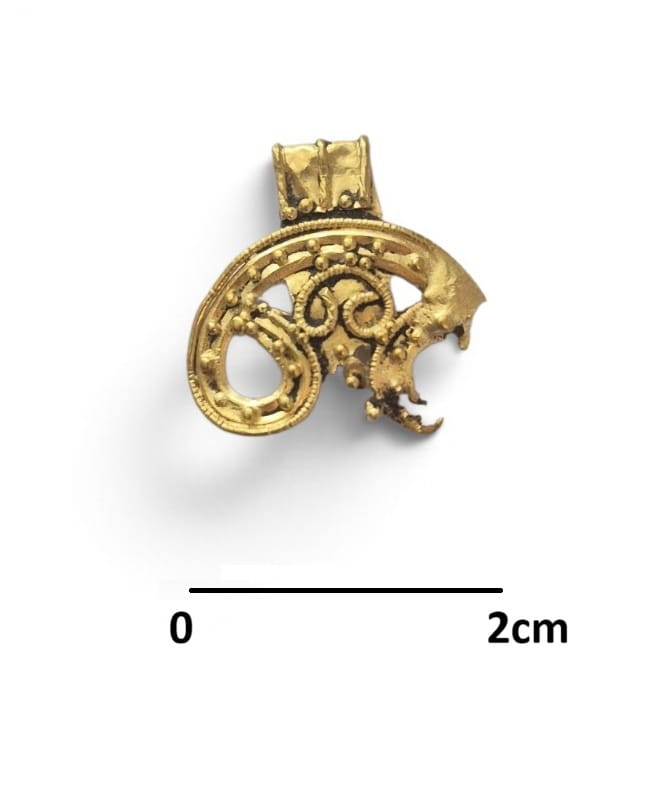
Photo: Port Polska
A burial ground near Baranów, in central Poland, has given up several thousand Roman-period finds after three years of careful digging. Archaeologists began work in 2023 and completed the full excavation this year, tracing the cemetery across more than one hectare of ground. Among the finds was one object the team describes as exceptional in Poland: a finely decorated metal pendant in the shape of a crescent moon.
The cemetery belonged to people of the Przeworsk culture, which flourished across much of present-day Poland from the third century BCE to the fifth century CE. The burial ground served its community for 200 to 300 years, recording local customs and social life across many generations. Most graves held cremated remains, in keeping with burial practice during the period. Ceramic urns often contained the ashes, while other objects accompanied the dead into the grave.
What the graves contained
The grave goods paint a clear picture of the community's daily life. Men's graves generally included weapons: swords, some bent or broken on purpose before burial, along with iron axes, spearheads and shield bosses, the metal fittings at a shield's center that protect the hand. Women's graves more often held pairs of fibulae, the brooches used to fasten clothing, along with beads and clay spindle whorls used to spin thread.
It is the kind of inventory that lets archaeologists read a cemetery like a record book. Weapons and tools, jewelry and household objects, placed with care beside the dead, show how the community divided work, marked status, and honored its people.
The crescent pendant
One of the rarest objects found was a finely decorated metal lunula pendant. The crescent-shaped piece carries delicate filigree work, fine threads of metal twisted into ornament. Many archaeologists link this form of jewelry with ancient lunar worship, and the Baranów example is described as exceptional in Poland. Port Polska, which announced the completion of the dig, calls the lunula unique on a national scale.
Crescent pendants appear in other ancient cultures too, but a piece of this quality, found in a fully excavated cemetery where its context is known, is a rare thing. It tells researchers not only about craft and trade, but about belief: the moon mattered enough to this community that someone was buried wearing it.
A site known for more than fifty years
Field surveys first noted the cemetery in the late 1960s and early 1970s. Archaeologist Stefan Woyda and his team found Roman-period pottery fragments and cremated human bones at the site. Woyda later helped set standard methods for archaeological field surveys across Poland, and his work helped lay the groundwork for the Archaeological Record of Poland, a national programme begun in 1978 to record and map sites across the country.
The recent excavation grew beyond its planned scope. Early work showed a much larger cemetery than expected, prompting archaeologists to expand the study until they mapped its full limits and nature. Such a complete investigation is rare in Poland, and it is one reason the results are so valuable: most cemeteries are only partly dug, leaving their edges and their full story unknown.
Digging ahead of an airport
The excavation was carried out by the firm Asinus Igor Maciszewski, selected through a public tender. The work was funded through the Port Polska investment programme, which is preparing a new airport and transport links between Warsaw and Łódź. The Mazovian Voivodeship Conservator of Monuments oversaw the work under heritage rules, and archaeological work was planned alongside airport preparation so that research and construction could proceed on schedule while documenting and protecting the site.
Fieldwork took place under difficult conditions. Deep ploughing had disturbed parts of the ground, while heavy clay made careful digging slow. After removing the topsoil, workers exposed graves and other features by hand with small hoes and fine tools, and checked excavated soil with metal detectors to avoid missing small objects. Drones, RTK GPS receivers and equipment for chemical testing helped record the site and support early study of the finds.
More than 80 percent of sites identified within the planned airport area have already been studied, and all known sites are due for excavation by the end of this year. A settlement from roughly the same period is being excavated nearby. Comparing the settlement with the cemetery will help researchers study both daily life and burial customs within the same community, a pairing archaeologists rarely get.
What happens next
After fieldwork, the objects will undergo laboratory study and conservation before transfer to museum collections. Regional heritage officials will help choose the museum and any future display site, so the lunula and the thousands of other finds should eventually be seen by the public rather than stored away.
For now, the Baranów cemetery stands as a reminder that major discoveries do not always come from untouched ground. This one was first spotted more than fifty years ago, disturbed by ploughs, and dug only because an airport was coming. Given time, patience and a full excavation, it turned out to hold one of the finest pieces of ancient jewelry found in Poland.
Source: https://archaeologymag.com/2026/11/burial-ground-in-baranow-poland-yields-thousands-of-finds/ — Archaeology News Online Magazine, 26 Nov 2026; original announcement by Port Polska.


Comments
Post a Comment