A Tiny Scorpion Fossil from Alabama Rewrites North America's Scorpion Story
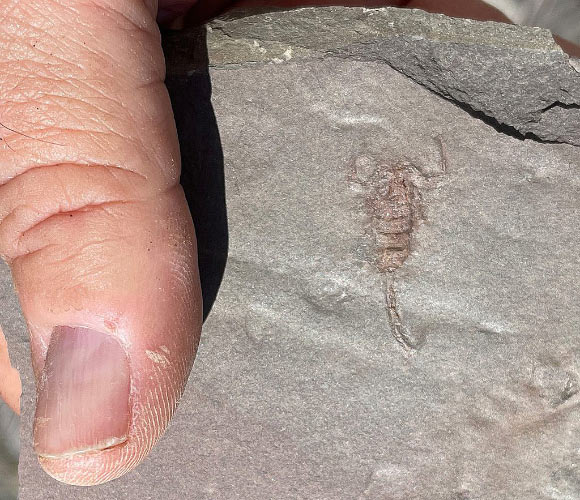
Photo: Prescott Atkinson
A fossil no bigger than a thumbnail has turned out to be a record-breaker. Dug out of a coal mine in Alabama, it is a scorpion that lived roughly 316 to 319 million years ago — and it is the oldest known member of the modern scorpion lineage ever found in North America.
The animal comes from the Union Chapel Mine in Walker County, Alabama, a site in the Pottsville Formation that fossil hunters have worked for about 25 years. The mine is famous for its fossilized footprints and trackways, left by ancient animals walking across mud that later turned to stone. Until now, though, no scorpion body fossil had ever been found there. This one is also the first fossil scorpion from anywhere in the southeastern United States.
A young scorpion, shed skin and all
The fossil is only about 22 millimeters long, and the researchers think it is probably a molt — the shed skin of a young scorpion, left behind as the animal grew. That fits with what is known about scorpions of the time. Animals of 315 to 320 million years ago, including scorpions, millipedes and dragonfly relatives, were generally much larger than their modern counterparts, so a small specimen like this one was most likely a juvenile.
The work was led by Genevieve Conway, a paleontology student at Flinders University in Australia, working with colleagues from the American Museum of Natural History and the University of Alabama. Dr. Russell Bicknell of Flinders University and Dr. Adiel Klompmaker of the University of Alabama were co-authors on the study.
How ultraviolet light gave the fossil away
At first glance, the fossil is a faint shape in the rock. To read it properly, the team shone ultraviolet light on it, which brought out details that are hard to see under ordinary lighting. The images revealed what appear to be breathing pores, called spiracles, sitting within the belly plates rather than along their edges.
That small detail mattered a great deal. The position of the spiracles places the animal in a group called Orthosterni, the lineage that includes every living scorpion. Curved lines on the plates may also be traces of book lungs, the breathing organs modern scorpions use. The specimen is missing some features, such as the plates at the base of the legs and the side eyes, but the features it does have were enough to identify it.
Chemical analysis added another clue. The fossil is made almost entirely of carbon, which fits with heat having changed the chitin of the original shell over hundreds of millions of years.
The Alabama scorpion is also clearly different from the only other scorpion known from the Pottsville Formation, which has lobed belly plates. The new specimen's plates are shaped differently, marking it out as a separate kind of animal.
A tail built for venom
The fossil's shape tells a story about how it lived. It has a wide, large metasoma — the long tail segment that ends in a venomous stinger — and small, narrow pincers. In living scorpions, that combination is associated with animals that rely heavily on venom for defense and for catching prey, and that often hunt small, fast-moving insects.
The site itself keeps on giving. A recent report described shark teeth from the same mine, and the researchers say the finds together are building an increasingly detailed picture of the ancient ecosystems of Alabama. Some trackways at the site were made by scorpions, the team notes, although they cannot say whether an animal of this size made them.
Why this fossil matters
The Alabama specimen helps narrow down when modern-type scorpions first appeared. Until now, the only other comparably early and complete orthostern scorpion came from Britain, with older fragmentary remains known from Scotland. The Alabama find puts the modern scorpion body plan firmly in North America at a very early date — well before dinosaurs roamed the planet.
Perhaps the most striking point is how familiar the animal looks. Despite its great age, the species closely resembles scorpions alive today, including those in Australia. A body plan that works does not need to change, and this little scorpion is proof that the modern scorpion design was already in place more than 300 million years ago.
Source: https://www.sci.news/paleontology/carboniferous-orthostern-scorpion-15219.html — study published in The Science of Nature.


Comments
Post a Comment