Two New Tardigrade Species Discovered on an Undersea Mountain off West Africa
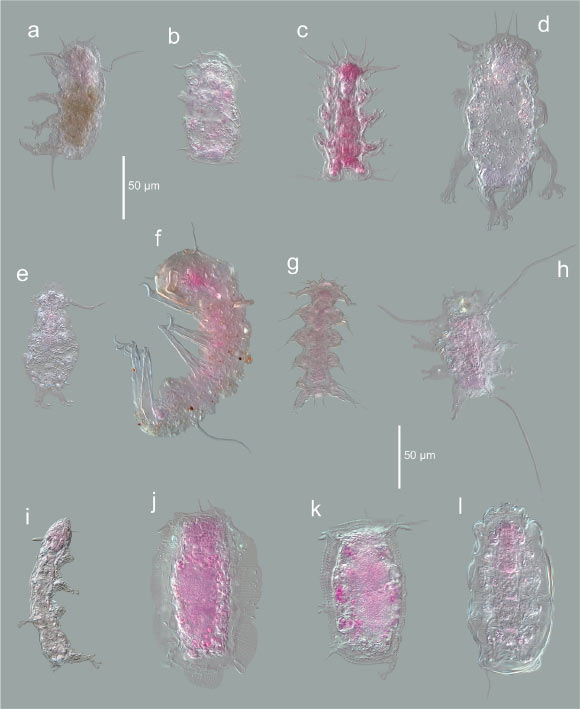
Photo: Trokhymchuk et al.
Most people who have heard of tardigrades picture water bears — the tiny, hardy animals of moss and lichen, famous for surviving extreme cold, heat, radiation and even the vacuum of space. But the tardigrade family is far broader than that. Many of its members live in the sea, in the spaces between grains of sand and seafloor sediment, from shallow coastal waters to the deep ocean. Tardigrades are microscopic animals, most of them smaller than a millimeter, and they turn up almost everywhere on Earth, from mountain moss to the deep sea. Two new marine species have now been discovered on an undersea mountain off the coast of West Africa.
The two species, named Megastygarctides hekatae and Parastygarctus potercha, live on Senghor Seamount, a volcanic peak rising from the seafloor in the Cabo Verde region of the Atlantic. They were found by a team of marine biologists from the Netherlands, Germany, Denmark and Ukraine, led by Dr. Roman Trokhymchuk, a researcher at the Dutch Naturalis Biodiversity Center and the German Centre for Marine Biodiversity Research, Senckenberg am Meer.
Samples from a 2009 expedition
The samples that yielded the new species were collected back in 2009, during a research cruise of the German research vessel Meteor at Senghor Seamount. The study is the first systematic investigation of the marine tardigrade fauna at this seamount, and it turned up far more than the two new species.
In sediment from the seamount's summit, roughly 100 to 130 meters below the surface, the team identified 20 different kinds of tardigrades. By contrast, a deep-sea site about 100 kilometers to the north, at a depth of nearly 3,300 meters, yielded just two. The difference was striking, and it supports the idea that undersea mountains are unusually rich habitats, even for animals barely visible to the naked eye.
Two animals smaller than a grain of sand
The new species are both microscopic. Megastygarctides hekatae measures less than 200 micrometers long — about the width of two human hairs. It is notable for rare spine-like structures near its genital opening, a feature previously known in only one other tardigrade species.
Parastygarctus potercha is even smaller, about 70 micrometers long. It appears to retain juvenile traits into adulthood, such as having fewer claws than most of its relatives. In tardigrade terms, it is an animal that never quite grows up.
Marine tardigrades belong largely to a separate lineage, the Heterotardigrada, and they are often strikingly different from their land-dwelling cousins. Some have armor-like plates, elaborate sensory appendages and ornate claws — a far cry from the plump, eight-legged water bears of popular imagination. They inhabit the gaps between sand grains and other seafloor sediments, a hidden world that most people never see.
Undersea mountains as oases of life
The discovery matters because of where it was made. Seamounts — underwater volcanic peaks — are increasingly recognized as hotspots of marine life. The Senghor results add to that picture: the marked difference in tardigrade numbers and diversity between the seamount plateau and the deep-sea floor nearby is further evidence that seamounts can be veritable oases of biodiversity, as Dr. Alexander Kieneke, a marine scientist at Senckenberg am Meer, put it.
Other Atlantic seamounts tell a similar story. On the Faroe Bank, another plateau in the Atlantic, as many as 35 species of tardigrades have been documented. Yet the deep sea remains largely unexplored, and the researchers say it is reasonable to assume that biodiversity in other regions has been underestimated so far. If a single seamount summit can hold 20 kinds of tardigrade, many of them undescribed, the total diversity of these animals is likely far larger than the current records suggest.
The work also shows the value of looking again at old samples. The sediment sat in collections for years after the 2009 cruise before the team examined it in detail, and systematic surveys of such material, the researchers argue, can still reveal new species and reshape ideas about where marine life thrives. With the deep sea still largely unexplored, and seamounts already proving to be rich habitats, the true diversity of marine tardigrades is likely far larger than the current records suggest — and some of it may already be sitting in museum collections, waiting for someone to take a closer look.
Source: https://www.sci.news/biology/two-new-species-marine-tardigrades-underwater-mountain-west-africa-15214.html — study published in ZooKeys.


Comments
Post a Comment